Aug 21, 2026, 4:58:18 PM

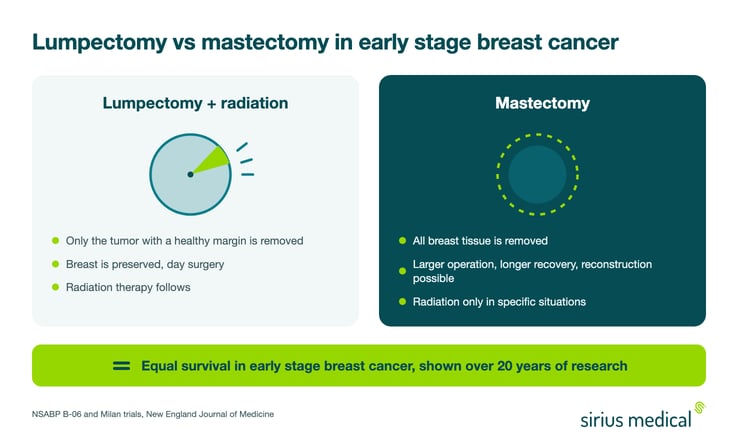
For most women with early stage breast cancer, the choice between a lumpectomy and a mastectomy is not a choice between a safer and a riskier operation. Four decades of research show that breast conserving surgery followed by radiation therapy offers the same survival as mastectomy for early stage disease. The real differences lie elsewhere: in radiation, recovery, appearance, follow up and how each option fits your life and your diagnosis. This article puts the two side by side so you can have a better conversation with your surgical team.
What Each Operation Involves
A lumpectomy, also called breast conserving surgery, partial mastectomy or in the UK a wide local excision, removes the tumor with a rim of healthy tissue while preserving the breast. How the operation works step by step is described in Lumpectomy Procedure. A mastectomy removes all breast tissue. Modern variants can preserve the skin envelope and sometimes the nipple, which improves the starting point for reconstruction, either immediate or delayed. Which lymph nodes are removed is a separate decision that applies to both operations and is covered in Targeted Axillary Dissection.
Survival: What Forty Years of Research Shows
Two landmark trials followed women for twenty years after surgery and reached the same conclusion. The American NSABP B-06 trial (doi: 10.1056/NEJMoa022152) and the Italian Milan trial (doi: 10.1056/NEJMoa020989), both published in the New England Journal of Medicine, found no survival difference between mastectomy and breast conserving surgery with radiation for early stage breast cancer. More recent population studies, such as a Dutch registry analysis of over 37,000 patients in The Lancet Oncology (doi: 10.1016/S1470-2045(16)30067-5), point in the same direction. Removing more tissue does not buy more safety in early stage disease; what matters is that the tumor is removed completely, with clear margins, and that radiation follows when the breast is preserved.
Radiation Therapy: the Part That Comes With Lumpectomy
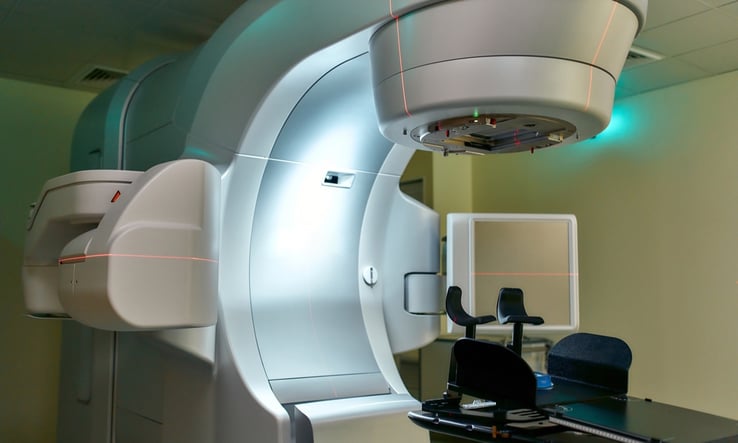
Breast conserving surgery is really breast conserving therapy: the operation is almost always followed by radiation to the remaining breast tissue, typically starting a few weeks after surgery. Modern schedules are shorter than they used to be, often one to three weeks of daily sessions. After a mastectomy, radiation is only needed in specific situations, for example when lymph nodes are involved. For some women the daily logistics of radiation weigh heavily; for others it is a modest price for keeping the breast. To aim the extra radiation dose at the right spot, radiation oncologists use markers left in the tumor bed during surgery, explained in Tumor Bed Localization.
Recovery, Appearance and Follow Up
A lumpectomy is usually day surgery with a recovery of one to a few weeks. A mastectomy is a larger operation, often with a hospital stay, drains, and a recovery of several weeks, longer when combined with reconstruction. Cosmetically, a lumpectomy preserves the breast, and oncoplastic techniques can reshape the tissue during the same operation to keep a natural contour, as described in Oncoplastic Breast Surgery Techniques. A mastectomy changes the body more fundamentally, with or without reconstruction. Follow up also differs: a preserved breast keeps being screened with mammograms, while after a mastectomy imaging of that side is generally no longer routine.
When a Mastectomy Is Recommended
Sometimes the choice is made by the diagnosis rather than by preference. A mastectomy is usually advised when the tumor is large relative to the breast, when there are multiple tumors in different parts of the breast, when extensive DCIS is present, covered in DCIS Surgery and Localization, when the breast has been irradiated before, or when radiation is not possible. Women with a strong genetic predisposition may choose mastectomy to reduce future risk. The National Cancer Institute describes these considerations in its treatment overview.
Questions to Ask Your Surgeon
- Am I a candidate for breast conserving surgery, and if not, what specifically rules it out?
- How will the tumor be localized during surgery if it cannot be felt?
- What is your re excision rate for unclear margins after lumpectomy?
- What would the radiation schedule look like in my case?
- If I need a mastectomy, which reconstruction options fit my situation and their timing?
Why Precise Localization Matters in This Choice
Many early stage tumors today are found on screening before they can be felt. For a lumpectomy to succeed, the surgeon must find and remove exactly that non palpable tumor with clear margins, which is why the lesion is marked and localized before surgery, described in Surgery for Non Palpable Breast Cancer. Precise localization is part of what makes breast conservation a reliable option: the more accurately the target is defined, the less healthy tissue needs to be removed and the lower the chance of a second operation for unclear margins, a topic explored in Surgical Margins in Breast Conserving Surgery.
Frequently Asked Questions
Do lumpectomy and mastectomy have the same survival rates?
For early stage breast cancer, yes. Long term randomized trials and large registry studies show equivalent survival for breast conserving surgery with radiation compared with mastectomy. Your own situation can differ, so discuss what the evidence means for your specific diagnosis.
Is the risk of recurrence higher after a lumpectomy?
The risk of a new tumor in the preserved breast is small and is the reason radiation follows the operation and screening continues. Distant recurrence risk, which drives survival, is the same for both operations in early stage disease.
Can I choose a mastectomy even if a lumpectomy is possible?
Yes. When both options are oncologically sound, the choice is yours, and it is legitimate to weigh radiation logistics, follow up, appearance and peace of mind differently than someone else would.
What is a wide local excision?
It is the term used in the UK and elsewhere for the same operation as a lumpectomy: removal of the tumor with a margin of healthy tissue while conserving the breast.
What is a nipple sparing mastectomy?
A mastectomy that removes the breast tissue while preserving the skin and nipple, usually combined with immediate reconstruction. It is an option in selected cases where the tumor is not close to the nipple.
How Sirius Medical Supports Breast Conserving Surgery
The promise of breast conservation stands or falls with surgical precision. Sirius Medical developed the Pintuition System® to help surgeons remove non palpable tumors accurately the first time. Before surgery the Pintuition Marker®, a non radioactive and permanent magnetic marker, is placed in the tumor under image guidance, and during the operation GPSDetect™ technology provides continuous distance and direction to the target. In the French 200 case series by Ceccato and colleagues in Scientific Reports (doi: 10.1038/s41598-025-88430-5), 100 percent of lesions were successfully excised with re excision rates of 7.6 versus 9.1 percent, and Elisabeth TweeSteden Hospital in the Netherlands has performed more than a thousand Pintuition® guided procedures.
Interested in Improving Surgical Localization?
Learn how Pintuition® can support precision, workflow efficiency and reliable excision in breast conserving surgery. Request demo or explore the clinical overview for more information.
Disclaimer
This article is intended for informational purposes only and should not be considered medical advice. Clinical decisions should always be made by qualified healthcare professionals based on individual patient needs and current guidelines.