Sep 21, 2026, 4:53:36 PM

Being told that a breast lump needs to come out is unsettling, even when your doctor has already said it is probably nothing serious. Most breast lumps turn out to be benign, and the operation to remove one is usually short, day case surgery. What differs from person to person is why the lump is being removed and, just as importantly, whether the surgeon can feel it. This article explains the types of breast lump removal surgery, how the two paths differ, what happens on the day, and how surgeons find a lump they cannot feel.
Why a Breast Lump Is Removed
A breast lump gets removed for one of three reasons. The first is diagnostic: imaging and a needle biopsy have not given a clear enough answer, so the whole area is taken out to be examined. The second is treatment: the biopsy has confirmed cancer, and surgery removes the tumor along with a rim of surrounding tissue. The third is symptomatic: the lump is benign but large, growing or painful, and removing it is simply the practical solution. Most breast lumps fall in the last category. The American Cancer Society describes the range of non cancerous breast conditions, from simple cysts to fibroadenomas, that account for the majority of lumps found in the clinic.
The reason for surgery shapes everything that follows: how much tissue is taken, whether lymph nodes are involved, and what happens after the operation. It is worth asking your surgeon directly which of the three applies to you, because the answer changes what a good result looks like.
Types of Breast Lump Removal Surgery
The terminology is confusing because different countries and specialties use different words for overlapping operations.
- Excision biopsy, sometimes called a diagnostic excision. The lump is removed whole so a pathologist can examine it. Used when needle biopsy results are unclear or discordant with the imaging.
- Lumpectomy, also called breast conserving surgery, wide local excision or segmental mastectomy. The cancer is removed with a margin of healthy tissue around it, and the rest of the breast is kept. This is the standard operation for most early breast cancers and is covered in detail in Lumpectomy Procedure.
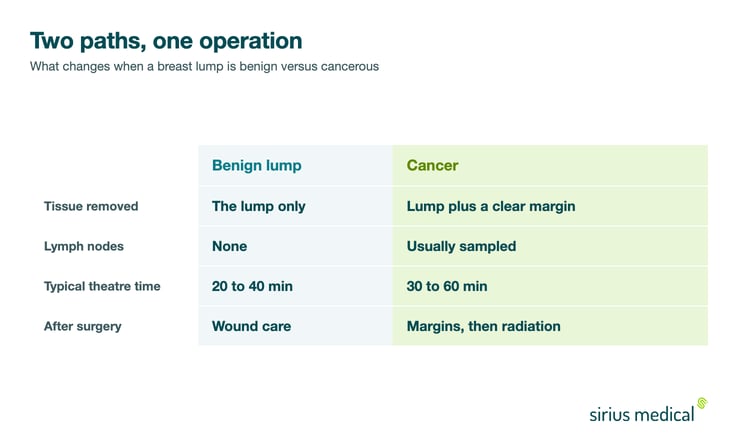
- Benign lump excision, for example removing a fibroadenoma or a recurring cyst. Same surgical principle, but no margin of extra tissue is needed and no lymph nodes are involved.
- Mastectomy, removal of the whole breast. Considered when the cancer is large relative to the breast, when there are several tumors in different areas, or by patient choice. The trade offs are set out in Lumpectomy vs Mastectomy.
For a benign lump the operation is often 20 to 40 minutes under general or local anesthetic, and most people go home the same day. For cancer the operation is longer, because the surgeon also needs to achieve clear margins and may need to sample lymph nodes in the armpit.
The Difference That Decides How Your Surgery Goes
There is one question that changes the shape of the operation more than almost anything else, and it rarely gets explained: can the surgeon feel the lump?
A lump you can feel through the skin is called palpable. The surgeon can locate it by hand during the operation, make the incision above it and take it out. A lump that only shows up on a mammogram, ultrasound or MRI scan is called non palpable, and increasingly that is the case, because screening finds cancers long before anyone can feel them. A non palpable lesion cannot be found by touch once the patient is asleep and the breast is draped, so the surgeon needs something to navigate by.
That is why a marker is placed. During the original biopsy a small marker is left at the sampled spot, a practice explained in Clip Marker in Breast Cancer, and before or during surgery a localization device tells the surgeon exactly where that spot is. Without it, a surgeon operating on a lesion the size of a pea inside a breast is working blind. The full range of approaches is set out in Preoperative Localization in Breast Surgery and in Surgery for Non Palpable Breast Cancer.
What Happens on the Day of Surgery
Whether the lump is benign or malignant, the day follows a recognizable pattern.
- You arrive fasted, usually a few hours before the operation, and meet the surgeon and anesthesiologist.
- If the lesion is non palpable, localization happens first. With a wire this means a separate radiology appointment on the morning of surgery, with the wire left protruding from the breast until you go to the operating room. With a marker placed earlier, this step is already done and you go straight to the operating room.
- The operation itself is typically 20 to 60 minutes, depending on the reason and whether lymph nodes are sampled.
- The removed tissue is usually X-rayed straight away so the team can confirm the target has been taken out before you leave the operating room.
- Most people go home the same day, with a dressing, a supportive bra and simple pain relief.
The tissue then goes to pathology. Results usually take one to two weeks, and for a cancer operation they include whether the margins are clear. What that means, and what happens when they are not, is explained in Surgical Margins in Breast Conserving Surgery.

Questions Worth Asking Your Surgeon
These five questions get you the information that actually affects your experience, and they are easy to ask in a short appointment:
- Is my lump palpable, or will it need to be localized before surgery?
- If it needs localization, which method will be used, and does it mean an extra appointment on the morning of surgery?
- Is this operation for diagnosis, for treatment, or because the lump is causing symptoms?
- Will any lymph nodes be removed, and if so how many?
- When will I get the pathology results, and who will call me?
Recovery After Breast Lump Removal
Recovery after a benign lump excision is usually quick: soreness for a few days, a supportive bra for one to two weeks, and normal activity within a week or so. After a lumpectomy for cancer the timeline is longer, and radiation therapy usually follows a few weeks later.
Some bruising and firmness at the site is expected in both cases and does not mean something has gone wrong. A firm, tender swelling can be a hematoma, which is common and normally resolves on its own; the signs that do warrant a call are listed in Hematoma After Breast Biopsy. Scar tissue at the site can feel like a new lump for months, which is worth knowing in advance so it does not cause unnecessary alarm at the first follow up.
Frequently Asked Questions
Is breast lump removal surgery painful?
The operation itself is done under anesthetic, so you feel nothing. Afterwards most people describe soreness and bruising rather than sharp pain, controlled with simple pain relief for a few days. Sensitivity around the scar can last longer.
How long does breast mass removal surgery take?
A straightforward benign lump excision is often 20 to 40 minutes. A lumpectomy for cancer typically takes 30 to 60 minutes, longer if lymph nodes are also sampled. Time in hospital is much longer than time in the operating room, because of preparation and recovery.
Does removing a breast lump leave a scar?
Yes, but surgeons place the incision to minimize how visible it is, often along the edge of the areola or in a natural skin crease. Scars fade considerably over the first year. Where a larger volume of tissue is removed, oncoplastic techniques can reshape the breast at the same time, as described in Oncoplastic Breast Surgery.
What is the difference between an excision biopsy and a lumpectomy?
An excision biopsy removes the lump to find out what it is. A lumpectomy removes a confirmed cancer together with a margin of healthy tissue around it. The surgical act looks similar, but the intent, the amount of tissue taken and the follow up are different.
Will I need my lymph nodes removed?
Only if the lump is cancerous. Lymph nodes are not touched in benign lump removal. When cancer is confirmed, a small number of nodes are usually sampled first rather than all of them being cleared, an approach explained in Sentinel Lymph Node Dissection.
Can a breast lump grow back after removal?
A benign lump that is fully removed does not usually return in the same place, although new lumps can appear elsewhere, particularly with fibrocystic changes. After cancer surgery, clear margins and the treatment that follows are what reduce the risk of local recurrence.
How Sirius Medical Contributes
The hardest version of this operation is the one where the surgeon cannot feel the target. Sirius Medical developed the Pintuition System® for exactly that situation. The Pintuition Marker® is a non radioactive, permanent magnetic marker that can be placed during the original biopsy, sometimes weeks before surgery, so no wire needs to be inserted on the morning of the operation. During surgery, GPSDetect™ technology gives the surgeon continuous distance and direction to the marker, and TargetLOC™ confirms when the probe is aligned directly above it. The signal stays accurate in blood, fluid and hematoma and is not disturbed by electrocautery.
In a French series of the first 200 cases, published by Ceccato and colleagues in Scientific Reports (doi: 10.1038/s41598-025-88430-5), 39.5 percent of markers were placed 2 to 29 days before surgery, all lesions were successfully excised, and the re-excision rate was 7.6 percent. A Stanford comparison against an alternative wireless localization technique, reported by Chinn and colleagues in Annals of Surgical Oncology (doi: 10.1245/s10434-025-18354-x), found a median operating time of 37 minutes versus 50 minutes. Elisabeth TweeSteden Hospital in the Netherlands has now performed more than a thousand Pintuition® guided procedures.
Interested in Improving Surgical Localization?
Learn how Pintuition® can support precision, workflow efficiency and reliable excision in breast cancer surgery. Request demo or explore the clinical overview for more information.
Disclaimer
This article is intended for informational purposes only and should not be considered medical advice. Clinical decisions should always be made by qualified healthcare professionals based on individual patient needs and current guidelines.